"I Can't Sleep" — What Your Anxious Child Actually Needs to Hear

It's 9:47 PM. You've done the routine. You've read the books. You've done the tuck-in. You've said goodnight.
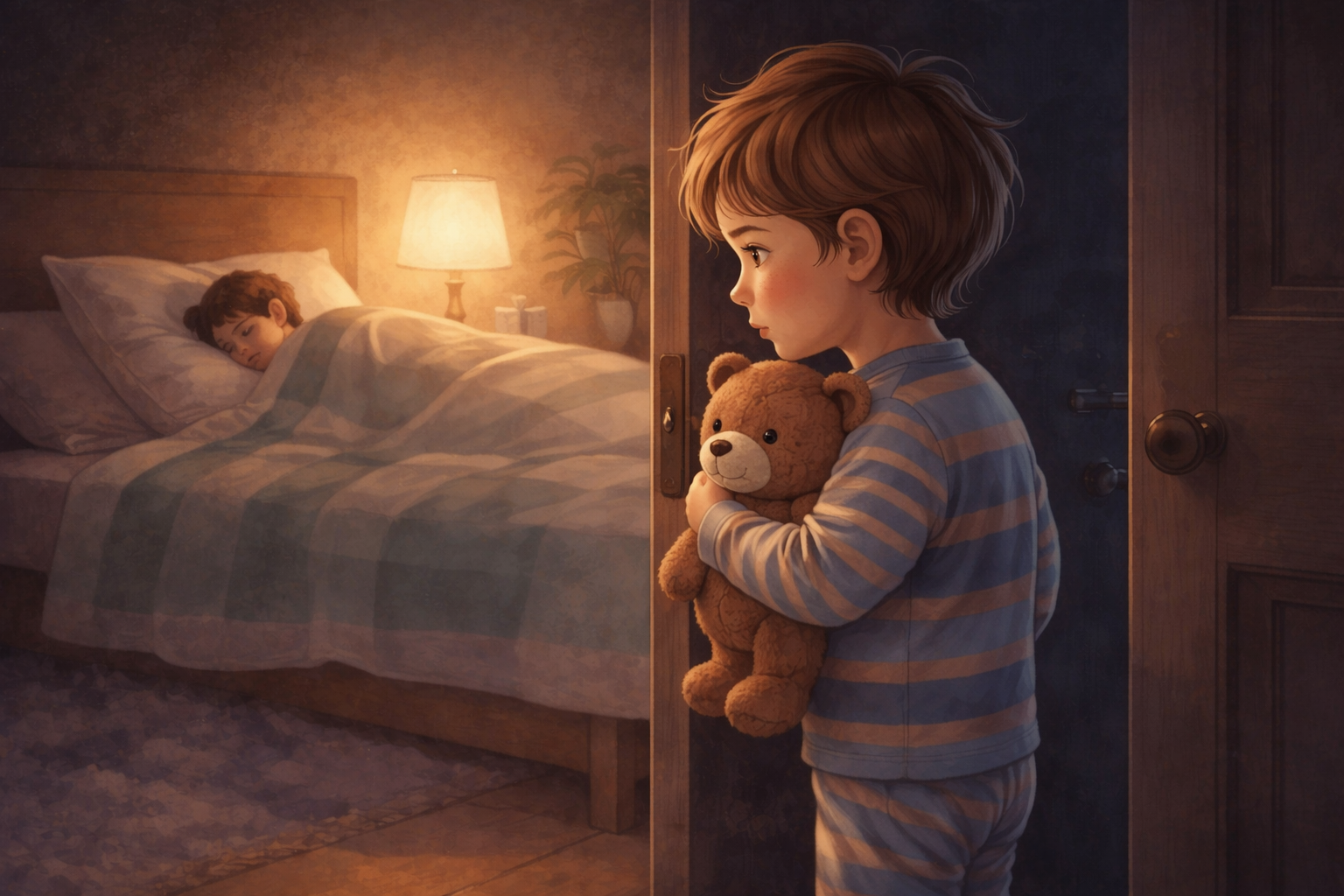
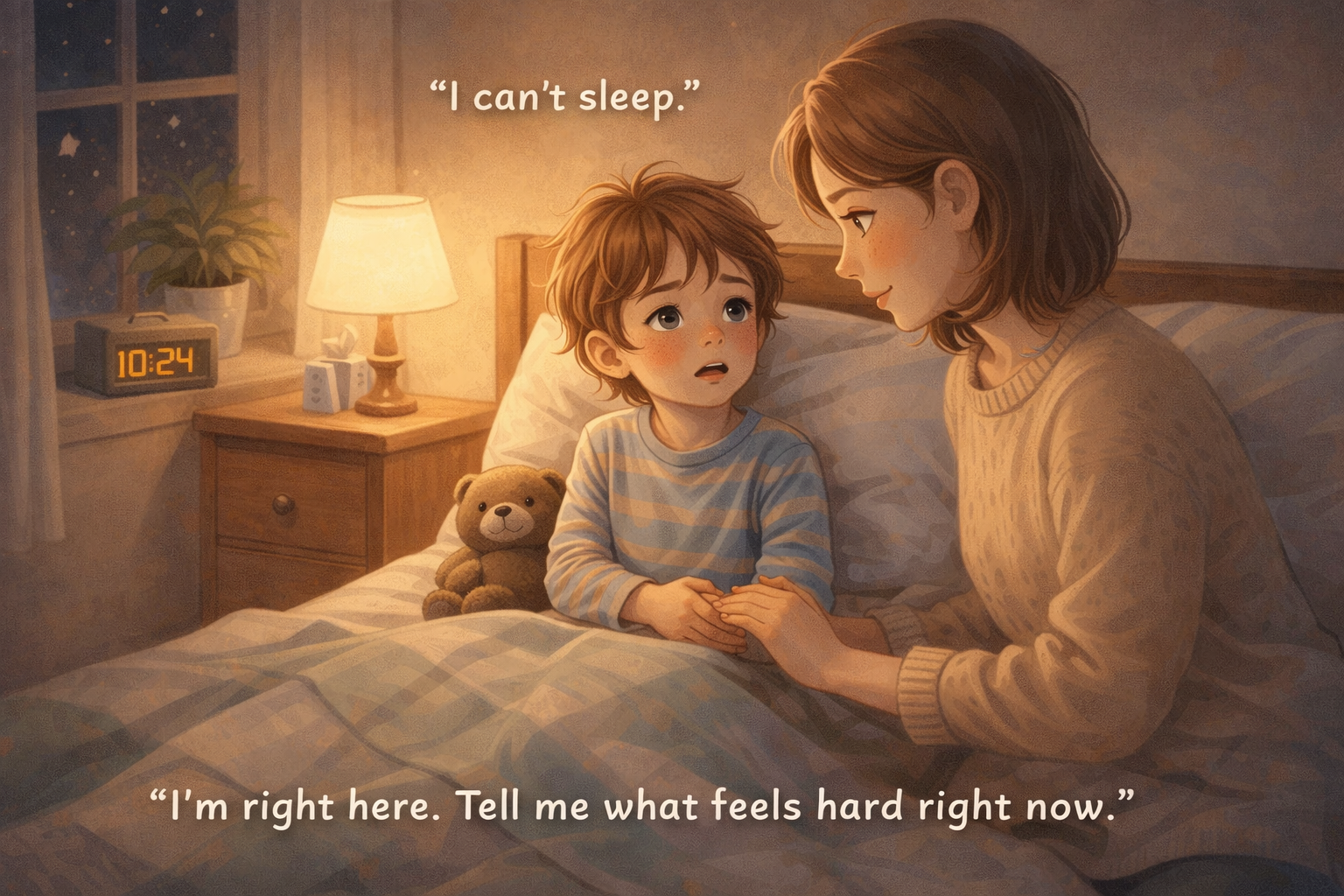
And there it is — the small voice from the dark room:
"I can't sleep."
Your gut reaction — the one you're trying very hard not to say — is some version of "just close your eyes and try." Maybe with a side of "you haven't even been in here for five minutes."
I know. I've been there. I've said both of those things. And I've watched them make everything worse.
Here's what I've learned: when an anxious child says "I can't sleep," they're not asking for sleep advice. They're asking for help. The words you choose in that moment matter more than you think.
What They're Actually Saying
"I can't sleep" is almost never about sleep. It's the simplest way your child can communicate something much bigger:
- "My brain won't stop." Their mind is cycling through worries — some real, some imagined, all of them loud. They can't find the off switch because it doesn't fully exist yet in their developing brain.
- "I'm scared to be alone with my thoughts." During the day, there are distractions everywhere. At night, it's just them and whatever their brain decides to serve up. For an anxious child, that's terrifying.
- "I need to know you're still here." Your presence is their regulation system. When you leave the room, they lose access to the thing that keeps them calm. "I can't sleep" is often "I can't feel safe enough to let go."
- "I don't know how to make this feeling stop." They're experiencing a physical stress response — racing heart, tight chest, churning stomach — and they have no idea what it is or what to do about it. "I can't sleep" is the closest description they have for "my body won't calm down."
The Words That Make It Worse
Before the good stuff, let's clear out the phrases that backfire. Not because you're a bad parent for using them — because most of us have, and they're the default responses for a reason. They just don't work for anxious kids.
"There's nothing to worry about." This tells their brain it's wrong about what it's feeling. Their brain will not accept that. It'll double down. Now they're anxious AND they feel dismissed.
"Just close your eyes." They've tried. Their eyes pop open because their nervous system is on guard duty. This makes them feel like they're failing at something that should be easy.
"You need to go to sleep. You're going to be tired tomorrow." Congratulations — you've just added a new worry to the pile. Now they're anxious about being anxious. This is the anxiety spiral in action.
"I already said goodnight. Go to bed." Clear boundary, sure. But for an anxious child, this translates to: your fear is inconvenient to me. They won't come to you next time. They'll just lie there alone with it. That's not the outcome you want.
The Words That Actually Help
Every effective response follows the same three-step pattern: validate → name → next step. You don't need to memorize scripts. You just need to remember those three moves.
Validate: Let them know what they're feeling is real and okay. Name: Help them identify what's happening — in their brain, in their body. Next step: Give them one small, concrete thing to do.
Here's what that sounds like in practice:
When they say "I can't sleep":
"I know. Some nights are harder than others. Your brain is probably doing a lot of thinking right now. Let's give it something calm to focus on — can you listen and count how many breaths I take?"
Why this works: You didn't argue. You didn't fix. You gave them an anchor — your breathing — that redirects their brain from the worry loop to something rhythmic and present.
When they say "I'm scared":
"I hear you. That worry feeling can be really loud at bedtime. Where do you feel it in your body right now?"
Why this works: You're teaching them interoception — the ability to notice what's happening inside their body. This is a foundational skill for managing anxiety at any age. And asking "where do you feel it" shifts them from being inside the fear to observing it, which creates distance.
When they say "what if something bad happens":
"That sounds like your Worry Cloud talking. It loves bedtime — that's when it gets the loudest. What do you think we should tell it tonight?"
Why this works: You've externalized the anxiety. It's not THEM that's afraid — it's the Worry Cloud. This gives them agency. They're not helpless against their own brain. They can talk back to it.
When they say "can you stay":
"I'm going to sit right here for two more minutes. Then I'll be in the living room. You don't have to be asleep when I leave — just resting. And I'll come check on you in five minutes."
Why this works: You've given them a timeline (two minutes), removed the pressure (you don't have to be asleep), named where you'll be (living room — specific, not vague), and promised a check-in (five minutes). Four concrete facts for their brain to hold onto instead of worry.
When they say "I keep thinking about [specific fear]":
"Thank you for telling me that. That sounds like a really sticky thought. Let's do something with it — can you imagine putting that thought in a box? What color is the box? Okay. Now let's put the box on a shelf. It can stay there tonight. You don't have to carry it."
Why this works: For young kids, visualization is powerful because their thinking is concrete. They can't "let go" of a thought on command. But they can imagine putting it somewhere. The sensory details (what color?) make it feel more real and give their brain something to do besides worry.
The Pattern Behind All of This
You'll notice that none of these responses try to talk kids out of their feelings or rush them toward sleep. That's intentional.
An anxious brain at bedtime is like a car alarm going off. You can't reason with it. You can't yell at it to stop. You have to find the source and address it — calmly, specifically, one step at a time.
The three moves — validate, name, next step — work because they speak to each layer of what's happening. The validation calms the emotional brain. The naming engages the thinking brain. And the next step gives the body something to do.
You won't nail this every night. Some nights you'll be too tired, too touched-out, too frustrated to find the right words. That's okay. What matters is the pattern over time, not any single night.
Want the Whole Toolkit?
This post covers what to say. But bedtime anxiety is bigger than words — it's also about routine, environment, and understanding what's actually happening in your child's brain when the lights go off.
I put everything I've learned into one comprehensive guide: the full bedtime routine framework, the tools that actually work (and the ones to skip), when to worry about the worrying, and more.
If your child is between 3 and 7, Chase and the Worry Cloud gives them their own language for this. The Worry Cloud isn't them — it's something that visits. And they can learn to talk back to it. A lot of parents have told me it's become the book their kid asks for on the hard nights.