What to Actually Do When Your Kid Is Melting Down
Your kid just lost it.
Maybe it was the wrong cup. Maybe their sister looked at them. Maybe you said no to something and now they're on the floor screaming like you cancelled Christmas.
And you're standing there — jaw tight, heart pounding, every nerve in your body screaming make this stop.
Here's what nobody tells you about this moment: your child is not the only one being hijacked by their nervous system right now. You are too.
So before we talk about what to do with your kid, we need to talk about what to do with you.
Start with your own body
You cannot regulate a child from a dysregulated body. It doesn't work. You'll either match their energy and escalate, or you'll shut down and disconnect. Neither helps.
So before you say a single word, do this: one breath. Unclench your jaw. Drop your shoulders away from your ears. Soften your hands.
You're not calming down because you're fine with what's happening. You're calming down because your nervous system is the only life raft in the room.
This takes three seconds. It changes everything.
Step 1: Say nothing
This is the hardest part. Your instinct is to talk — to reason, to explain, to fix. But a child mid-meltdown cannot process language. Their prefrontal cortex is offline. Words bounce off them or make it worse.
So just be near them. Don't lecture. Don't negotiate. Don't ask them what's wrong. Not yet.
Your calm, quiet presence is doing more work than any sentence could.
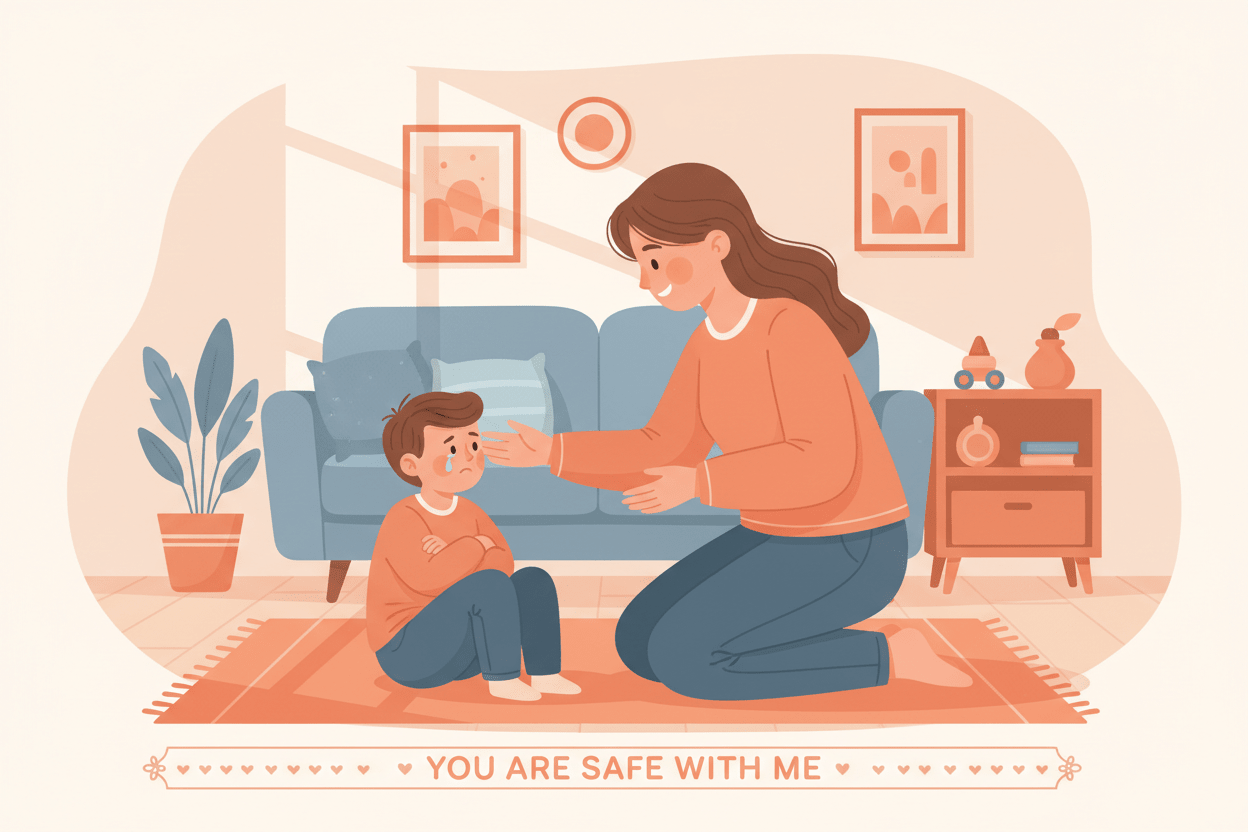
Step 2: Get low
Standing over a melting-down child feels like a tower. It's intimidating even when you don't mean it to be.
Get on the floor. Get eye level. Make your body say what your words can't yet: I'm not a threat. I'm not going anywhere.
Step 3: Name it simply
When the screaming starts to crack — when you see that tiny pause between sobs — say one thing.
"You're really upset right now."
That's it. You're not fixing anything. You're not agreeing with them. You're telling their brain: someone sees me. For a nervous system in full alarm mode, being seen is the first step back to safety.
Don't say "you're okay." They're not okay. They know they're not okay. Telling them they are breaks trust.
Step 4: Wait
A meltdown is a wave. It has a build, a crest, and a fall. You cannot rush it. You cannot logic your way through it. You ride it out.
This might take ninety seconds. It might take fifteen minutes. It will feel like four hours.
Stay. That's the whole job right now. Stay.
Step 5: Reconnect
When the wave starts to come down — when the sobs get softer, when their body unclenches — that's your window.
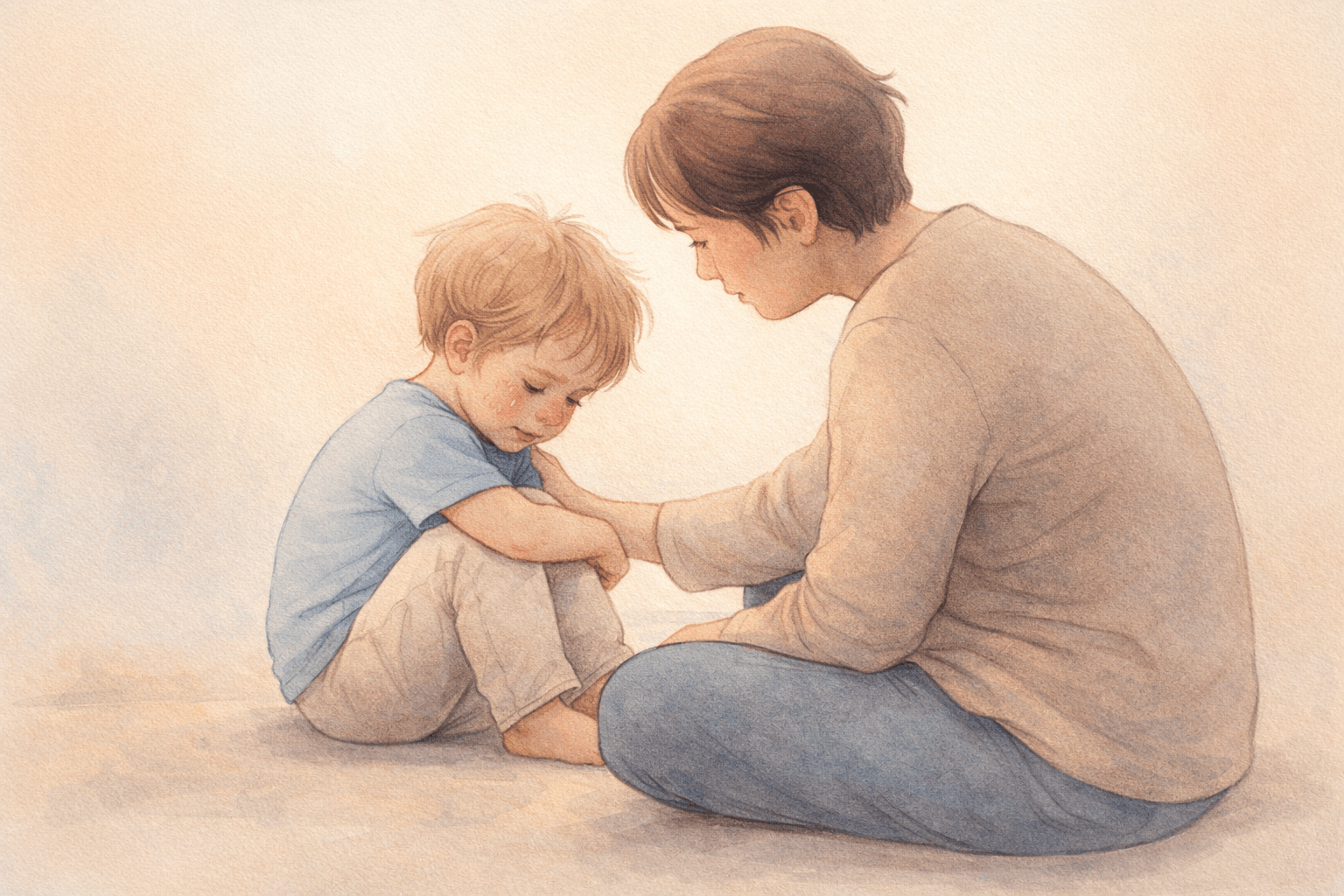
A hand on their back. A soft voice. "I'm right here." Maybe they crawl into your lap. Maybe they just lean against you. Maybe they need another minute before they can be touched.
Follow their lead. Don't rush the repair.
Step 6: Talk about it later
Not during. Not five minutes after. Later. When their brain is fully back online, when they've had a snack and some water and the world feels safe again.
"That was a really big feeling earlier, huh? What was going on?"
This is where the learning happens. Not in the middle of the storm, but in the calm after it. This is when you can name the emotion together, talk about what they could do differently next time, and remind them that having big feelings doesn't make them bad.
What this looks like at different ages
With a toddler, you might hold them through the whole thing without saying a word. Their world is body-first. Containment is comfort.
With a five-year-old, you might sit nearby and narrate gently. "Your body is really upset. I'm going to sit right here until it passes." They're learning that feelings have a beginning and an end.
With a nine-year-old, you might give them space first and check in after. "I could see you were flooded. Do you want to talk about it or just hang out?" They're learning that they can trust themselves to come back from the edge.
The approach shifts. The foundation doesn't. See them. Stay near. Don't punish the feeling.
The truth no one says out loud
Sometimes you will do everything right and it will still be a disaster.
You'll breathe and get low and name the feeling and your kid will scream louder. You'll stay calm for twelve minutes and lose it on minute thirteen. You'll handle the morning meltdown beautifully and completely fall apart at the bedtime one.
That's not failure. That's parenting.
What matters isn't getting it perfect every time. What matters is that more often than not, your child looks up from their worst moment and sees someone who stayed.
That's how safety gets built. Not in the easy moments. In the hard ones.
And the fact that you're reading this — that you're looking for a better way — means you're already that person.